Google Ads Management That Brings You Buyers, Not Just Clicks
Confia is a Google Ads management agency for B2B and service businesses. We build Search, Performance Max and YouTube campaigns around one goal: qualified leads you can turn into revenue.
- Commercial-intent keyword strategy, not keyword stuffing
- Conversion tracking wired to your CRM, so Google optimises for leads that close
- Weekly search-term cleanup and honest monthly reporting
18+ years in paid media · $5M+ ad spend managed · 300+ customers
Why Google Ads still matters for B2B
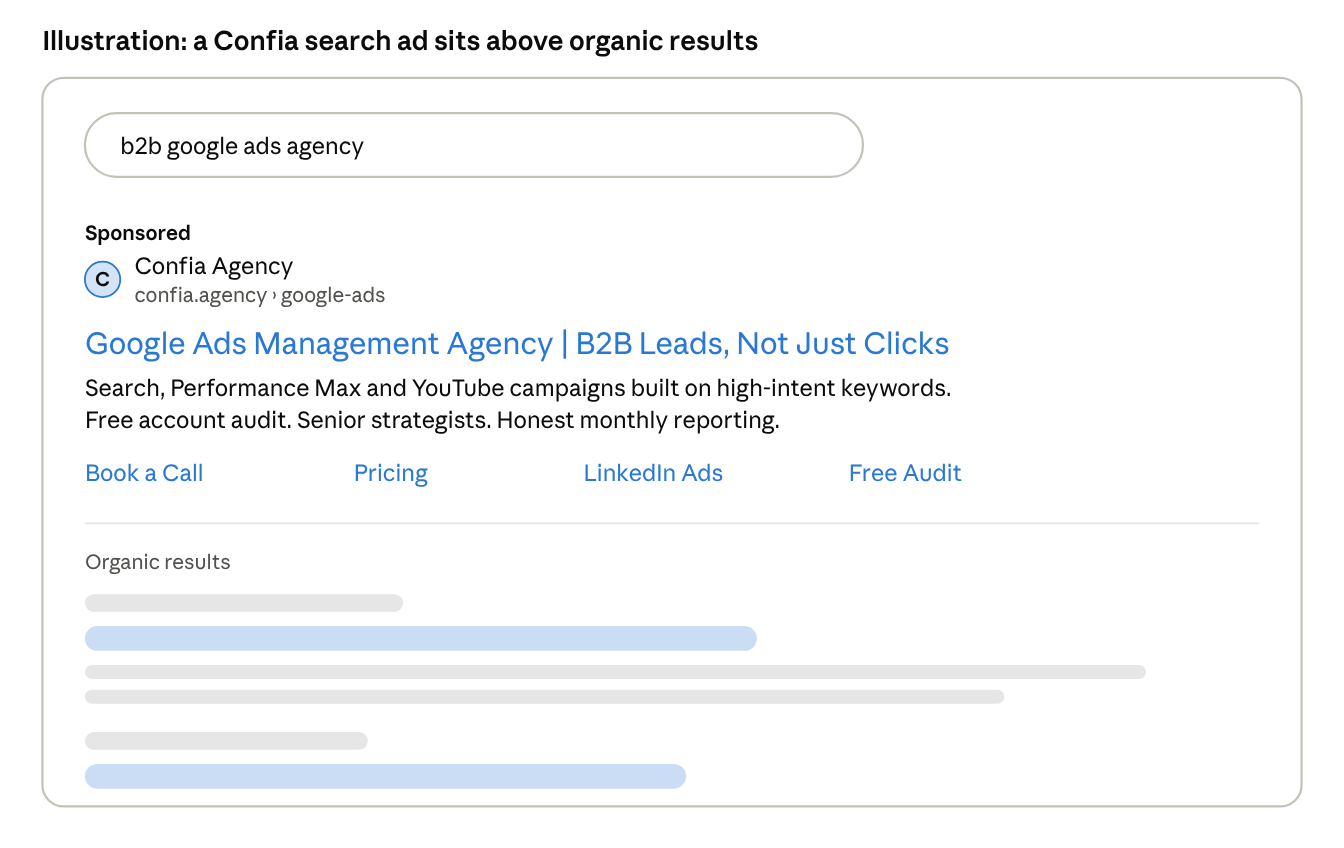
When someone types “hire a virtual assistant company” or “ERP software for aviation” into Google, they are telling you what they want right now. Google’s own help centre describes Search campaigns as a way to show ads to people actively searching for your products and services. That is the difference between Google and most other channels: you do not have to create the need, you only have to show up well when it appears. Confia’s job is to make sure you appear for the searches that lead to sales, and not for the ones that only burn budget.
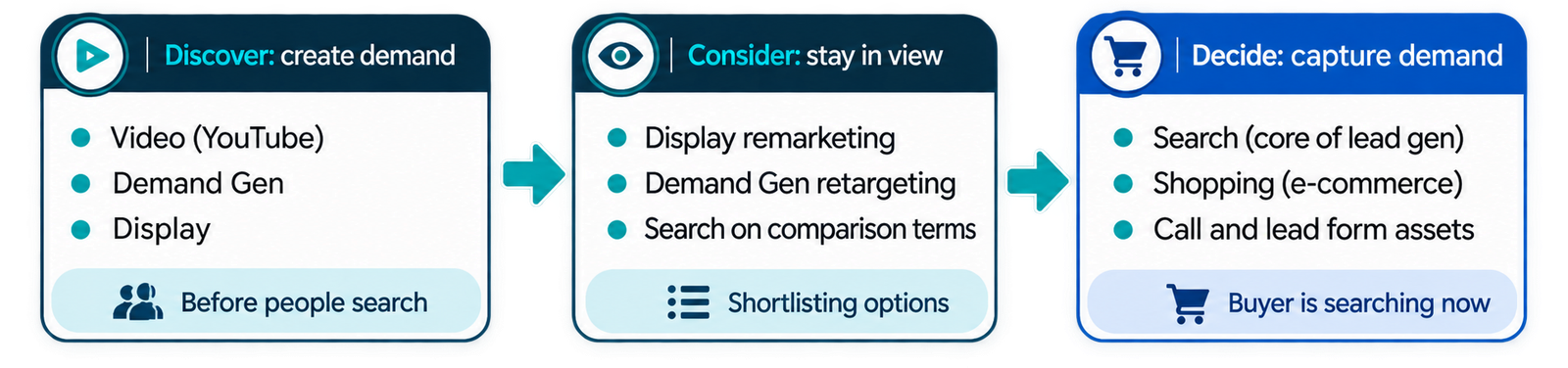
Types of Google Ads campaigns (and when we use each)
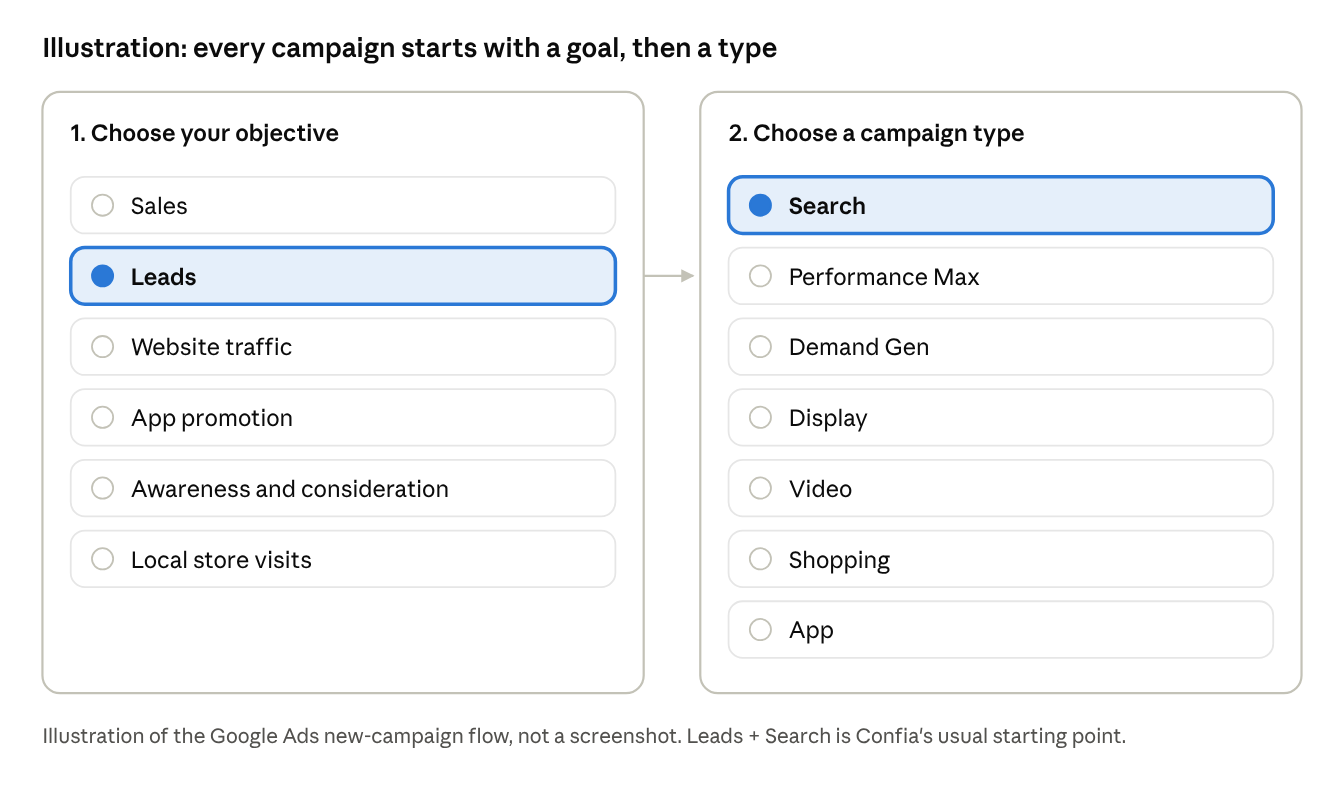
Google Ads starts with a goal, then a campaign type. The type decides where your ads show and what they look like. Here is how we choose:
Search
Where ads show: Google search results and search partners
Ad format: Text ads (responsive search ads)
Best for: Capturing people already looking for your service
How Confia uses it: The core of almost every lead-gen account we run

Performance Max
Where ads show: Search, YouTube, Display, Discover, Gmail and Maps from one campaign
Ad format: Text, image, video and more, assembled by Google AI
Best for: Scaling conversions once tracking is solid
How Confia uses it: Added after Search is profitable, with brand exclusions and negative keywords

Demand Gen
Where ads show: YouTube (incl. Shorts), Discover, Gmail, Display Network
Ad format: Image, video and carousel ads
Best for: Creating demand before people search; lookalike audiences
How Confia uses it: Mid-funnel, paired with LinkedIn ABM to warm target accounts

Display
Where ads show: Websites and apps in the Google Display Network
Ad format: Image ads
Best for: Remarketing and awareness at low cost
How Confia uses it: Mostly remarketing to site visitors

Video
Where ads show: YouTube
Ad format: Video ads
Best for: Brand recall, explainer content, thought leadership
How Confia uses it: Founder / executive video, retargeting

Shopping
Where ads show: Google Shopping and search results
Ad format: Product listings from Merchant Center
Best for: E-commerce
How Confia uses it: Only for product-led clients

App
Where ads show: Search, Play, YouTube, Display
Ad format: App promotion ads
Best for: Installs and in-app actions
How Confia uses it: On request

What you need to run Google Search ads
A Search campaign has more moving parts than most businesses expect. Before launch we collect or build the following:
A clear goal and conversion action.
Leads, calls or booked demos. Set the conversion category correctly (for example "Submit lead form", "Book appointment" or "Qualified lead").
Conversion tracking.
The Google tag or Google Tag Manager on the site, plus enhanced conversions for leads so CRM outcomes (qualified, closed-won) flow back into Google Ads.
A dedicated landing page.
One page per service or intent, with the offer and the CTA from the ad repeated above the fold. Sending paid traffic to the homepage is the most common reason accounts underperform.
Responsive search ads.
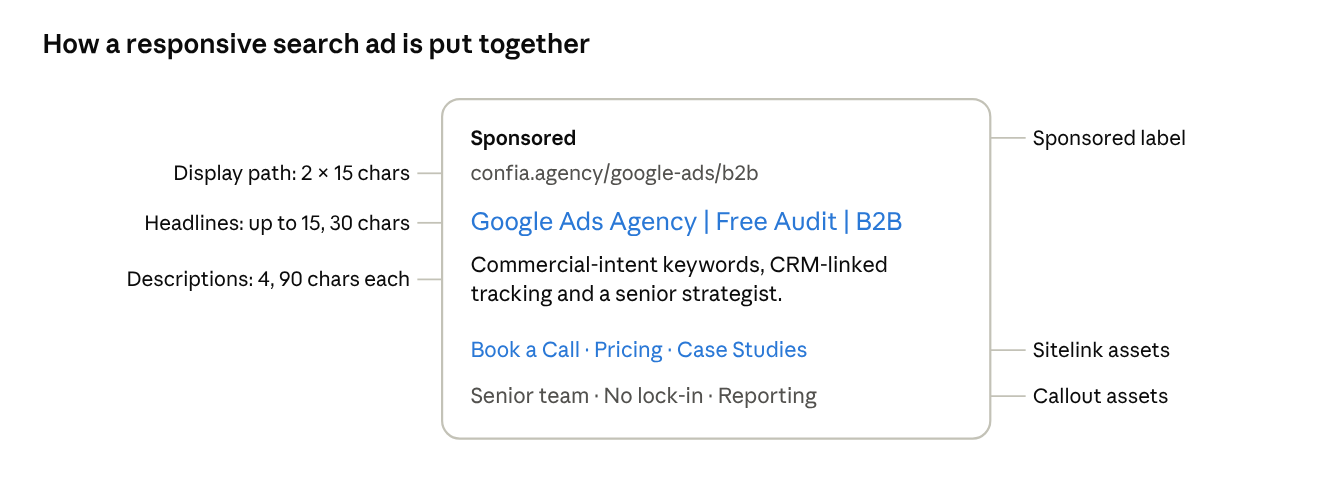
Up to 15 headlines (30 characters each) and up to 4 descriptions (90 characters each), with at least 3 headlines and 2 descriptions required. Two display-path fields of 15 characters each.
Campaign settings.
Name, network (Search only, partners on or off), locations, languages, budget, start date and bidding strategy.
Ad groups by theme.
Each ad group holds one tight cluster of keywords, for example "hire a virtual assistant" versus "data management services".
Assets (formerly extensions).
Sitelinks, callouts, structured snippets, call and lead form assets, images and business logo.
Audience segments in Observation.
Remarketing lists, customer lists and in-market segments layered on to learn, not to restrict.
Schedule, device and demographic settings.
Business hours, device bid adjustments and exclusions where data supports them.
Keywords with match types.
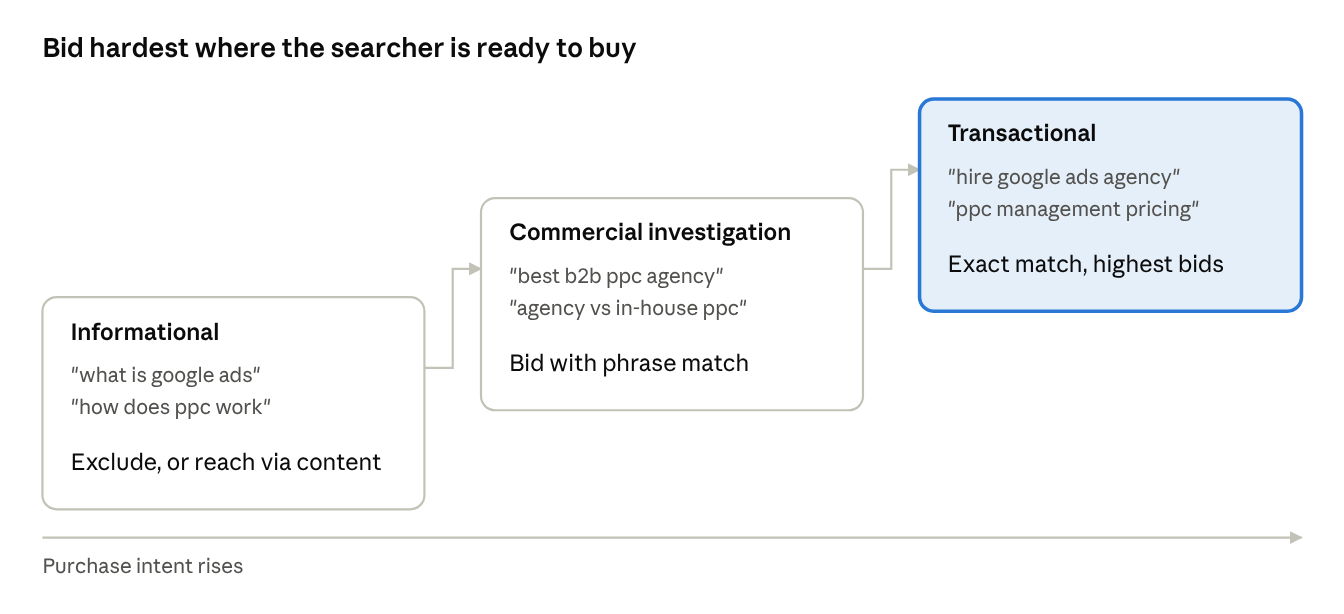
Broad, "phrase" and [exact], chosen for intent (more below).
How we target commercial-intent traffic
Most wasted spend comes from paying for curious searchers instead of buyers. Here is how Confia keeps budgets on people ready to act:
Build the keyword list from buyer language.
We prioritise modifiers that signal a purchase or shortlist: hire, agency, company, services, pricing, cost, quote, near me, best, vs, alternative, for [industry]. “Virtual assistant” is research; “hire a virtual assistant company” is commercial.
Use match types on purpose.
- Exact match [keyword] for the highest-value, proven terms. It gives the most control and reaches the fewest searches.
- Phrase match “keyword” for core service terms where the meaning must be present.
- Broad match only with conversion-based Smart Bidding and strong negatives, to discover new buyer queries. Google itself says Smart Bidding is critical when you use broad match.
Exclude the wrong intent.
Account- and campaign-level negative lists for jobs, careers, free, DIY, training, definitions and competitor support queries. Negative keywords do not match close variants, so we add plurals and synonyms by hand.
Read the search terms report every week.
It shows the real queries that triggered your ads. We add winners as exact keywords and losers as negatives.
Write ads that pre-qualify.
Mentioning a starting price, minimum engagement or audience (“for mid-size manufacturers”) lowers clicks from the wrong people and raises lead quality.
Separate brand and non-brand.
Brand campaigns protect your name cheaply; non-brand campaigns are where growth comes from. With Performance Max we use brand exclusions so it does not take credit for brand searches.
Layer audiences and first-party data.
Website visitors, CRM lists and LinkedIn-engaged accounts go in as Observation segments or Customer Match lists, so bids rise for people who already know you.
Feed back what a good lead looks like.
Enhanced conversions for leads sends hashed CRM outcomes back to Google, so the algorithm learns which clicks became customers.
Use AI Max with guardrails.
Google’s AI Max for Search expands reach with broad match and keywordless matching, text customisation and final URL expansion. We test it once tracking is solid, with brand controls and URL rules in place.
What actually matters in a Search campaign
Ad quality: relevance, expected CTR and landing page experience.
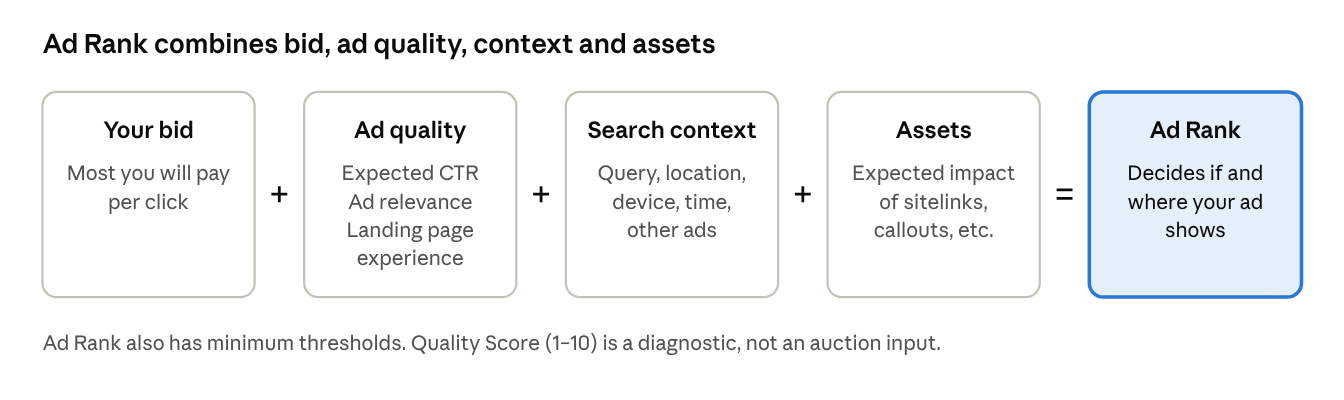
Google rates every keyword's Quality Score from 1 to 10 using three components: expected clickthrough rate, ad relevance and landing page experience. The score itself is a diagnostic and not an auction input, but the real-time versions of those three components are. Better quality helps your ad qualify to show, earn a higher position and often pay a lower CPC.
Ad Rank, not just bid.
Your position is set by Ad Rank: your bid, auction-time ad quality, Ad Rank thresholds, the context of the search, and the expected impact of your assets. Outspending a competitor does not guarantee the top spot; out-relevancing them often does.
Message match.
The headline should echo the search, and the landing page should deliver what the ad promised. If the ad says "Book a free demo", the demo form should be the first thing on the page.
Ad Strength and asset variety.
Write unique headlines that cover different benefits, proof points and CTAs. Keep each important keyword inside a single headline. Pin only one or two headlines that must always show.
Clean data for Smart Bidding.
Maximize conversions, Target CPA and Target ROAS are only as good as the conversions you feed them. Optimising to "form fill" brings form fills; optimising to "qualified lead" brings buyers.
Patience in the learning phase.
Automated bidding typically needs 1-2 weeks to settle, sometimes up to 6. We avoid big budget or target changes during that window.
Our Google Ads management process
Audit and goal setting
Account, tracking, landing pages, competitors.
Tracking setup
Google tag, GTM, enhanced conversions, CRM import.
Build
Campaign structure, keywords, negatives, ads, assets, audiences.
Launch and learn
2-6 week learning window with daily checks.
Optimise
Weekly search-term cleanup, ad testing, bid and budget shifts.
Report
Monthly report on cost per qualified lead and pipeline, not vanity metrics.
Why Confia
 1
Ads Setup
Google Ads, LinkedIn Ads and ABM under one roof, so Google search traffic and LinkedIn account targeting work together.
- 2
Engagement
Senior people on your account; no "set and forget".
- 3
Consideration
No lock-in promises or guaranteed rankings. Realistic forecasts based on your market.



Not sure your current account is spending well?
Frequently asked questions
How much should I spend on Google Ads to start?
It depends on your keyword costs and how many leads you need. We size the starting budget from keyword CPC estimates and your target cost per lead, so the campaign gets enough clicks to learn. Google also shows recommended budget levels in Performance Max and Demand Gen setup. We share a realistic range in the free audit before you commit.
How long until Google Ads brings leads?
Search ads can start showing within a day of approval, and many accounts see first leads in the first week. Smart Bidding needs a learning period, usually 1-2 weeks and sometimes up to 6, before results settle. We judge performance after that window, not after day three.
Should I use Search or Performance Max?
For most B2B and service businesses we start with Search, because it gives keyword-level control and clear search-term data. Once conversion tracking is reliable and Search is profitable, Performance Max can add reach across YouTube, Display, Gmail and Maps. We run them together with brand exclusions and negative keywords to avoid overlap.
Ready to stop paying for the wrong clicks?
Tell us about your goals and we will show you where your budget should go.